
Fighting feedback
and giving time for trust to grow

I created an online workshop to help employees at my company get better at giving and receiving feedback.
I asked my manager and teammates to complete the workshop and provide notes for how it could be improved.
I received feedback from my manager.
I scanned his list of suggestions for 18 seconds.
I closed the document, not wanting to read more. My defenses immediately rose up to protect me from the cruel criticism that would confirm that I am not smart and not good at my job and generally not good enough.
I raised my metaphorical fists, ready to jab back at the bulleted words on the Google Doc that I specifically created to receive this feedback from my manager. I stabbed in response, violently blaming the low quality platform I was forced to use. I pointed with arm outstretched, gesturing back to those that came before me as the ones responsible for the not-perfect content. I kicked at the subjective suggestions, declaring that everyone has a different style as I pushed away this flawed examination of my work.
It took nearly forty hours for me to return to the document that captured that feedback to proceed with edits.
Why is my mind reacting like I am physically under attack? Why is it so hard for me to receive this feedback?
To receive this feedback that I’ve requested.
To receive this feedback that is in no way personal or harsh or nagging or surprising.
To receive this feedback after teaching the strategies and using the tools that supposedly neutralize the life-threatening response one feels in the body when under attack.
It was the same at home, in the early days of living with John before we were married.
He asked me to scrub my coffee cup better (on the inside and outside, with soap, too!!!)
I denied wrong doing. I pointed to other things I did well. I accused him of being too clean, too strict in keeping a home.
I retreated into aggressive stewing, adding up, keeping score, ready to throw my own darts of criticism to keep us on the same field of play in this 1:1, me against him competition. That’s what successful coupledom is, right?
Five years later, last week, he asked me to scrub my coffee cup better (on the inside and outside, with soap, too!!!)
I peeked inside of the coffee stained mug and snickered.
That’s all.
No defensiveness (I’m indefensible! I saw the stains myself! I know I didn’t scrub with intention, just a cursory wipe down, a lackluster attempt at checking a box).
No snapping back to highlight all the other ways I do take care of our home.
No fever dreams at 2am, waking up to explain or chastise or blame myself for being a very bad partner and roommate.
Why am I able to receive this feedback, these notes on my coffee cup scrubbing performance?
What has changed in me that allows me to hear John’s requests as uncharged asks rather than accusations that pry at my value and worthiness?
Love is part of it. Over the last five years, my trust in John’s love for me has grown and I believe I am safe in our relationship. Love isn’t particularly replicable in the workplace, but the trust part is.
Trust was corporate-a-fied by Charles Green twenty-five years ago when he offered the Trust Equation to the working world.
I introduced this equation in the online workshop I created to help employees at my company improve at giving and receiving feedback. It’s framed as a useful, long term strategy to use when you want to develop trust with someone. To increase trust, I consistently work to increase my credibility, my reliability, and my intimacy (humanity) with others while decreasing my self-orientation, my self-centeredness.
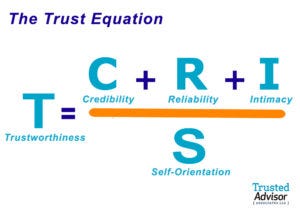
Stepping back from this tool and theory, I see that, of course I am reacting this way to feedback from my manager. I have been at my job for less than 3 months, not really enough time for me and others to feel confident in my credibility, my reliability, and build intimacy.
And, my self-orientation continues to remain high out of a desire to prove myself in these early days at a new job, rather than focusing my perspective on what is best for the company, the colleagues I am creating this workshop to support. I see this feedback as, not an effort to make the best workshop possible, but as a judgment of my abilities.
As with most good and true things, trust-building takes time, releasing defensiveness to feedback takes time (and practice!). I don’t know when, exactly, I stopped reacting so aggressively to John’s mug thoroughness requests, but I’m pretty sure it took years.
So, I will give myself time. I will make the effort to build trust with the people I work with. I will keep asking for feedback so that eventually I snicker at my mild mistakes and receive notes on my work with appreciation and neutrality.
